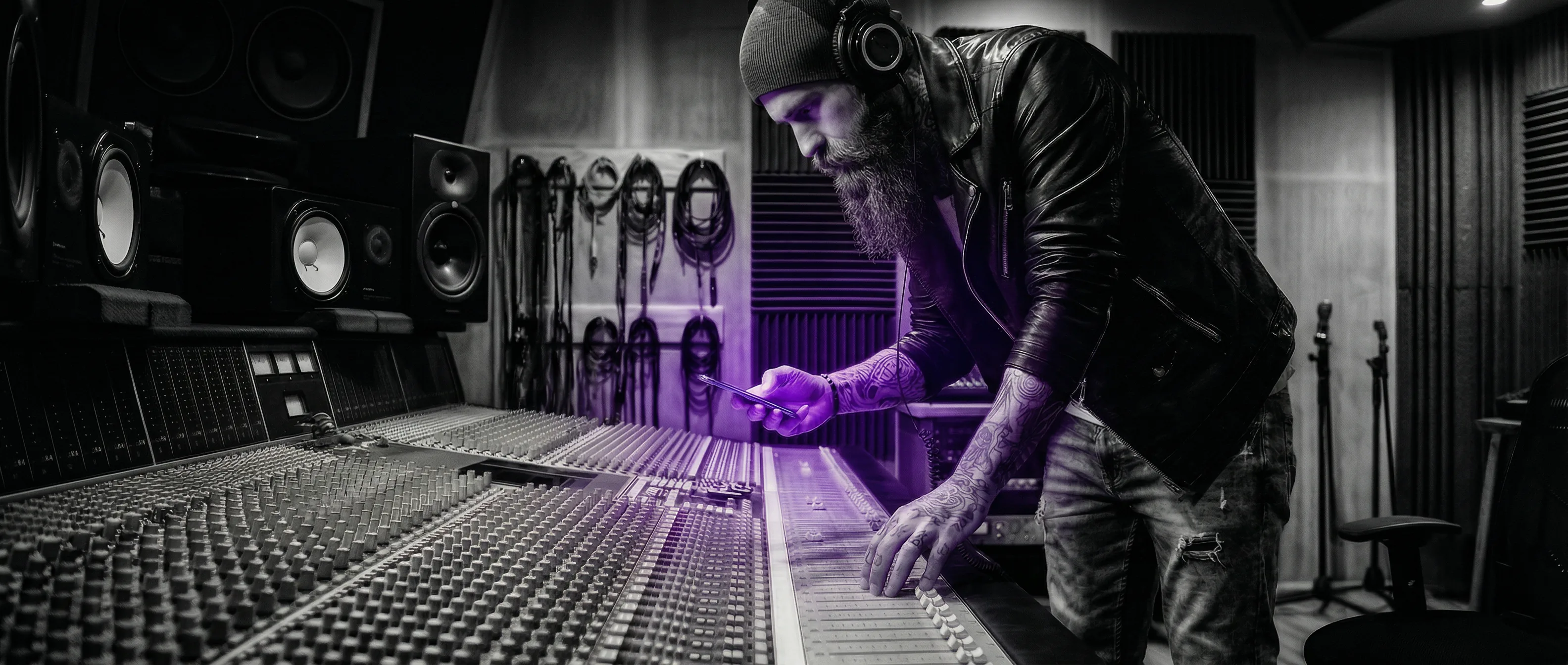
Subwoofer Calibration and Bass Management: Taming Low Frequencies with Mobile Measurement
A technical guide to subwoofer placement, crossover tuning, level matching, and room interaction — using DL Audiophile's measurement tools to achieve clean, controlled bass that integrates seamlessly with your main speakers.
Why Bass Is the Hardest Problem in Audio
Bass frequencies are the most physically demanding part of audio reproduction and the most affected by the environment they occupy. A midrange driver reproducing 1 kHz produces sound waves approximately 34 centimeters long — short enough that they propagate relatively freely in a typical room. A subwoofer reproducing 40 Hz produces sound waves approximately 8.6 meters long — longer than most rooms are wide. These long wavelengths interact powerfully with room boundaries, creating standing waves (room modes) that produce dramatic peaks and nulls in the bass response depending on where the subwoofer and listener are positioned.
The result is that bass performance in any real room is dominated not by the quality of the subwoofer but by the interaction between the subwoofer, its position, the room dimensions, and the listener's position. A high-end subwoofer in a bad position sounds worse than a budget subwoofer in a good position. A perfectly flat subwoofer measured in an anechoic chamber produces wildly uneven bass in a rectangular room. This is not a failure of the equipment — it is physics. And the only way to navigate these physics is measurement.
DL Audiophile provides the measurement tools that make subwoofer calibration systematic rather than subjective. Its Decibel Meter (SPL), Real-Time Analyzer (RTA), Frequency Response Analyzer, and Room Acoustics Analyzer give you the data to optimize placement, set crossover frequencies, match levels, and verify phase alignment. This guide walks through the complete subwoofer calibration process, from initial placement to final verification, using mobile measurement at every step.
Subwoofer Placement: Finding the Least Worst Position
There is no perfect subwoofer position in a rectangular room. Every position excites room modes differently, and the goal is not to eliminate modes (impossible without massive acoustic treatment) but to find the position that produces the smoothest, most even bass response at the listening position. The traditional advice — corner placement for maximum output, front wall placement for integration with the main speakers — is a starting point, not a solution. The solution requires measurement.
The most effective placement method is the subwoofer crawl, enhanced with DL Audiophile's SPL meter. Place the subwoofer temporarily at your listening position — on the couch, at ear height if possible. Play a bass frequency sweep or bass-heavy music at a consistent, moderate volume. Now crawl along the floor around the room's perimeter with your phone running DL Audiophile's Decibel Meter, listening and watching the SPL readings at each potential subwoofer location. The positions where the bass sounds most even and the SPL variations are smallest across different bass frequencies are the best candidates for subwoofer placement.
After identifying two or three candidate positions, move the subwoofer to each one and run DL Audiophile's Frequency Response Analyzer from the listening position. This measurement shows the bass frequency response — the actual SPL at each frequency from 20 Hz to 200 Hz — as produced by the subwoofer in that specific position and measured at your specific listening position. Compare the frequency response curves from each candidate position. The best position is the one with the fewest deep nulls (frequencies where the response drops dramatically) and the least severe peaks. A response with moderate peaks can be improved with EQ; a response with deep nulls cannot — those frequencies are being canceled by room modes and no amount of equalization can restore them.
Pay particular attention to the 60-80 Hz region, which is where most room modes are strongest and where the subwoofer crossover to the main speakers typically occurs. If the frequency response shows a deep null right at the crossover frequency, integration between the subwoofer and main speakers will be poor regardless of how carefully you set levels and crossover slopes. Move the subwoofer to a position where the crossover region is relatively smooth, even if the deep bass response is slightly less even.
A high-end subwoofer in a bad position sounds worse than a budget subwoofer in a good position. Measurement is the only way to navigate the physics of bass in a real room.
SPL Meter
Measure bass levels at candidate positions throughout the room to identify placements that minimize response variation at the listening position.
Frequency Response Analyzer
Visualize the complete bass frequency response from 20-200 Hz at the listening position — the definitive measurement for evaluating subwoofer placement.
Crossover Frequency and Slope: Seamless Integration with Main Speakers
The crossover frequency determines where the subwoofer stops playing and the main speakers take over. Set it too low, and there is a gap between the subwoofer's upper range and the main speakers' lower range — bass notes in that gap will be anemic or missing. Set it too high, and the subwoofer reproduces frequencies that localize to the subwoofer's position rather than blending with the main speakers, destroying the spatial illusion that good bass management creates. The ideal crossover frequency places the transition in a region where both the subwoofer and the main speakers can reproduce the content adequately, ensuring a smooth handoff.
The starting point for crossover frequency is based on your main speakers' bass capability. If your main speakers have a rated -3 dB point of 80 Hz, set the crossover at 80 Hz. If they extend to 60 Hz, set it at 60 Hz. The principle is simple: let the main speakers play as low as they comfortably can, and use the subwoofer only for frequencies below that. This minimizes the overlap region and reduces the opportunity for cancellation and comb-filtering between the sub and the mains.
Verify the crossover setting with DL Audiophile's RTA (Real-Time Analyzer). Play pink noise through the entire system and observe the RTA display at the listening position. A properly set crossover produces a smooth, continuous response through the transition region — no visible dip or bump where the subwoofer and main speakers hand off. If you see a dip at the crossover frequency, the two sources are partially canceling each other, which indicates a phase problem (addressed in the next section) or a crossover frequency set where a room mode creates a null. If you see a bump, the levels are overlapping — reduce the subwoofer level or lower the crossover frequency to reduce the overlap.
Crossover slope matters as well. A 12 dB-per-octave slope (second-order) produces a gradual rolloff with more overlap between the sub and mains. A 24 dB-per-octave slope (fourth-order) produces a sharper transition with less overlap. Steeper slopes reduce cancellation risk but are less forgiving of crossover frequency errors. If you have accurate measurement tools — which DL Audiophile provides — a steeper slope is generally preferable because you can set the crossover frequency precisely and the sharp transition minimizes the interference region.
Real-Time Analyzer (RTA)
Visualize the frequency response through the crossover region in real time — ensuring the subwoofer-to-speaker handoff is smooth and seamless.
Frequency Generator
Generate specific test tones at and around the crossover frequency to verify that both the subwoofer and main speakers contribute cleanly in the transition zone.
Phase and Time Alignment: The Invisible Integration Problem
Phase alignment is the single most overlooked aspect of subwoofer calibration, and often the single biggest improvement when corrected. If the subwoofer and main speakers are out of phase at the crossover frequency, the sound waves from each source partially cancel each other, creating a dip in response right where the handoff occurs. This cancellation makes the bass sound thin, weak, or disconnected from the rest of the frequency range — a problem that level adjustments and crossover tuning cannot fix because the cause is time-domain, not frequency-domain.
Most subwoofers have a phase control — a switch for 0 or 180 degrees, or a continuously variable knob from 0 to 360 degrees. To optimize this setting, play a test tone at exactly the crossover frequency (if your crossover is set to 80 Hz, play an 80 Hz tone) using DL Audiophile's Frequency Generator. Measure the SPL at the listening position with the Decibel Meter. Now slowly adjust the subwoofer's phase control while watching the SPL reading. The phase setting that produces the highest SPL at the crossover frequency is the correct setting — it means the subwoofer and main speakers are adding constructively rather than canceling.
If your subwoofer has only a 0/180-degree phase switch, the process is simpler but less precise: play the crossover-frequency test tone, measure SPL at the listening position, flip the switch, measure again. Use whichever setting reads higher. If neither setting sounds right, the issue may be time alignment: the subwoofer is physically farther from the listening position than the main speakers, so its sound arrives later. Many AV receivers offer distance compensation for the subwoofer, measured in feet or milliseconds of delay. Adjust this setting while monitoring the SPL meter until the bass reinforces rather than cancels.
Verify the final phase alignment with DL Audiophile's Frequency Response Analyzer. Measure the full system response from 20 Hz to 200 Hz. Compare this to the measurement you took during the placement step when only the subwoofer was playing. The combined system response should be equal to or greater than the individual subwoofer response at the crossover frequency. If the combined response shows a dip at the crossover that was not present in the subwoofer-only measurement, phase cancellation is still occurring and further adjustment is needed.
Phase alignment is the most overlooked aspect of subwoofer calibration and often the single biggest improvement when corrected. The correct phase setting is the one that produces maximum SPL at the crossover frequency.
Level Matching: Finding the Right Subwoofer Volume
Subwoofer level is the calibration parameter that most people adjust by ear — and most people set too high. The natural tendency is to turn up the subwoofer until you can feel the bass, which invariably overshoots the level that produces accurate, balanced reproduction. Excessive subwoofer level is the most common home audio calibration error, and it produces the boomy, one-note bass that gives subwoofers a bad reputation among listeners who value accuracy.
The correct method uses DL Audiophile's SPL meter and a calibration signal. Play band-limited pink noise (filtered to the subwoofer's operating range, typically 20-80 Hz) through the subwoofer alone and measure the SPL at the listening position. Then play full-range pink noise through the main speakers alone and measure the SPL. Adjust the subwoofer's volume control until the sub-only SPL matches the main-speaker-only SPL within 1-2 dB. This level-match ensures that the subwoofer integrates with the main speakers rather than dominating them.
After level matching with pink noise, verify with music. Play a recording with well-produced, natural bass — an acoustic bass, a grand piano, a kick drum in a jazz recording. The bass should sound like a natural extension of the main speakers, not like a separate source adding emphasis. If you can localize the bass to the subwoofer's physical position, the level is too high or the crossover frequency is too high. Well-calibrated bass is felt, not located. It should enhance the sense of fullness and weight without drawing attention to itself.
Use DL Audiophile's RTA to visualize the full-system response during music playback. The bass region (20-80 Hz) should sit at roughly the same level as the midrange (200 Hz - 2 kHz) on the RTA display. A bass region that consistently reads 5-10 dB above the midrange is too hot, regardless of how satisfying the impact feels. Accuracy and impact are not mutually exclusive — a properly calibrated subwoofer produces deep, tactile bass that integrates so seamlessly with the main speakers that removing it from the system sounds thin and incomplete, but its presence never calls attention to itself.
Decibel Meter (SPL)
Precisely match subwoofer output level to main speaker output — the objective measurement that prevents the most common subwoofer calibration error.
Room Acoustics Analyzer
Assess the overall acoustic behavior of your room including reverberation time and modal resonances that affect bass perception and calibration accuracy.
Final Verification: Confirming the Complete Calibration
After optimizing placement, crossover, phase, and level, the final step is a comprehensive measurement that confirms the entire system is working together correctly. Run DL Audiophile's Frequency Response Analyzer one final time with the complete system playing — subwoofer and main speakers together, all settings finalized. This measurement is your calibration reference — save it or screenshot it so you can compare against future measurements to detect if something changes.
The ideal response curve from 20 Hz to 200 Hz should be relatively smooth, with no peaks or dips exceeding about 6 dB. Peaks of 3-6 dB at room mode frequencies are normal and difficult to eliminate without acoustic treatment. Dips of 3-6 dB may be acceptable depending on the frequency — a dip at 35 Hz is less noticeable than a dip at 80 Hz where most musical content lives. The critical achievement is a smooth transition through the crossover region: no visible dip where the subwoofer and main speakers hand off, and no visible bump from overlap.
Walk around the listening area while monitoring the RTA. Bass response changes dramatically with position — this is unavoidable physics. But a well-calibrated system should produce acceptable bass at all primary seating positions, even if the optimal response is at the primary listening position where you performed the calibration. If a secondary seating position has dramatically different bass — booming or anemic — consider adding a second subwoofer at a different location, which smooths modal response across the room far more effectively than any single-sub placement optimization.
DL Audiophile's measurement tools brought objectivity to a process that is traditionally subjective and frustrating. The subwoofer is calibrated not because it sounds good to your ears at this moment — listening fatigue, room familiarity, and expectation bias all corrupt subjective assessment — but because the measurements confirm that the placement minimizes modal problems, the crossover integrates smoothly, the phase is aligned, and the level is matched. The result is bass that reveals what the recording contains, rather than what the room and the subwoofer impose on the recording.
Well-calibrated bass is felt, not located. It should enhance fullness and weight without drawing attention to itself. If you can point to the subwoofer, the calibration needs work.
Get DL Audiophile on Google Play
27 professional tools. Free. No ads. No premium tier.